Tack ska du ha, tack ändå and other thank-yous for advanced thankers
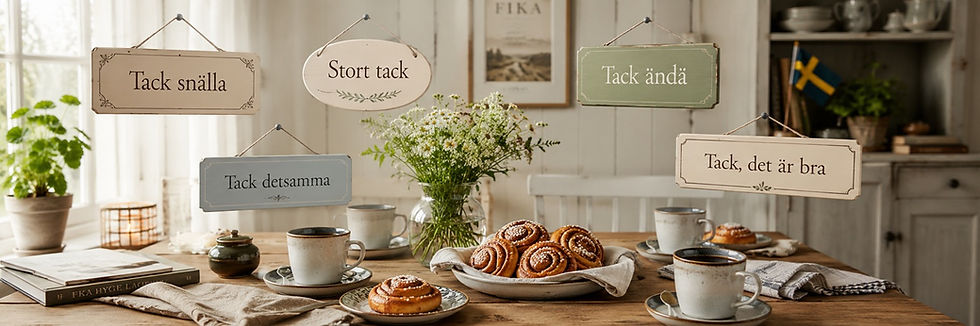
In a previous post, which you can read here, we looked at some common Swedish ways of saying thank you, including tack, tack tack, tack så mycket, tack själv and tack för senast.
But Swedish is not done there. Not at all. There are more thank-yous. Small thank-yous, big thank-yous, polite thank-yous, slightly sad thank-yous, and thank-yous that really mean: "No, but I am trying to sound pleasant".
So here is a follow-up. Perhaps a little advanced, but useful all the same.
Tack ska du ha / Tack ska ni ha
Tack ska du ha means roughly “thank you”, but it sounds a little warmer and more personal than just tack.
You use tack ska du ha when speaking to one person, and tack ska ni ha when speaking to several people.
At work:
– Jag har skrivit ut dokumenten åt dig. (I’ve printed the documents for you.)
– Tack ska du ha! (Thank you!)
After a course:
– Det var allt för idag. (That’s all for today.)
– Tack ska ni ha! (Thank you!)
This is a good phrase when someone has done something small but helpful. Not necessarily saved your life, but perhaps saved your printer from another nervous breakdown.
Tusen tack, stort tack and tack så hemskt mycket
Sometimes an ordinary tack is not quite enough. Someone has helped you a lot, replied quickly, looked after your cat, lent you a book or explained Swedish word order without crying.
Then you can say:
Tusen tack! (Thanks a million!)
Stort tack! (Many thanks! / A big thank you!)
Tack så hemskt mycket! (Thank you very much indeed!)
Examples:
– Jag kan hjälpa dig att flytta på lördag. (I can help you move on Saturday.)
– Tusen tack! (Thanks a million!)
– Jag har skickat informationen du behövde. (I’ve sent the information you needed.)
– Stort tack! (Many thanks!)
– Jag hittade din plånbok på bussen. (I found your wallet on the bus.)
– Tack så hemskt mycket! (Thank you so very much!)
Tack så hemskt mycket may sound a little dramatic. The word hemskt normally means something negative, something like “awful” or “terrible”. But in this context it means something like very.
Swedish does this sometimes. It takes a word that sounds faintly catastrophic and turns it into politeness. The language has its own methods.
Tack snälla
Tack snälla
Tack snälla is warm, friendly and quite personal. It works well when someone does something thoughtful for you.
Examples:
– Jag tog med din laddare. (I brought your charger.)
– Tack snälla! (Thank you, that’s so kind!)
– Jag kan köra dig till stationen. (I can drive you to the station.)
– Tack snälla, vad gulligt av dig. (Thank you, that’s really kind of you.)
– Jag sparade en bit tårta till dig. (I saved you a piece of cake.)
– Tack snälla! (Thank you, you lovely person!)
You can also say:
Tack snälla du! (Thank you, that’s so kind of you!)
This sounds even a little warmer. Perfect when someone does something extra thoughtful, such as saving cake. After all, that is an act of great social importance.
Tack för idag, tack för ikväll and tack för igår
Tack för idag, tack för ikväll and tack för igår are all about when something happened.
Tack för idag is often used after a lesson, workday, course, outing or activity.
After a Swedish lesson:
– Då slutar vi här. Tack för idag! (We’ll stop there. Thanks for today!)
– Tack för idag! (Thanks for today!)
After a meeting:
– Bra, då ses vi nästa vecka. Tack för idag. (Great, see you next week. Thanks for today.)
Tack för ikväll is used when you are leaving after something that took place in the evening, for example a dinner or a party.
After dinner at friends’ house:
– Nu ska vi nog gå hem. Tack för ikväll! (We should probably head home now. Thanks for this evening!)
– Tack själva, vad roligt att ni kom. (Thank you, we’re so glad you came.)
Tack för igår is used the day after.
In a text message:
Tack för igår! Det var jättetrevligt. (Thanks for yesterday! It was really lovely.)
At work after a party:
– Tack för igår! (Thanks for yesterday!)
– Tack själv, kul att ses utanför konferensrummet. (Thank you too, nice to see you outside the conference room.)
So the difference is:
Tack för idag = after something that happened today. (Thanks for today.)
Tack för ikväll = when you are leaving something in the evening. (Thanks for this evening.)
Tack för igår = the day after. (Thanks for yesterday.)
A small time machine of politeness.
Tack i alla fall
You use tack i alla fall when someone tried to help you, even if it did not quite work out.
Examples:
– Tyvärr hittade jag inte nyckeln. (Unfortunately, I didn’t find the key.)
– Okej, tack i alla fall. (OK, thanks anyway.)
– Jag kan inte svara på den frågan. (I can’t answer that question.)
– Nej, jag förstår. Tack i alla fall. (No, I understand. Thanks anyway.)
– Bussen har redan gått. (The bus has already left.)
– Jaha. Tack i alla fall. (Oh well. Thanks anyway.)
It means roughly: “It didn’t turn out the way I hoped, but I appreciate the attempt".
A very useful thank-you for when the world refuses to co-operate, but you still wish to remain a functioning member of society.
Tack ändå
Tack ändå is similar to tack i alla fall, but it often has a slightly more final feeling, like a polite little full stop.
Examples:
– Jag kan tyvärr inte hjälpa dig idag. (Unfortunately, I can’t help you today.)
– Okej, tack ändå. (OK, thanks anyway.)
– Vi har inte den storleken kvar. (We don’t have that size left.)
– Nej, okej. Tack ändå. (No, OK. Thanks anyway.)
– Jag vet faktiskt inte. (I actually don’t know.)
– Ingen fara, tack ändå. (No worries, thanks anyway.)
Tack ändå means something like: “You couldn’t help me, but thank you anyway".
It can sound completely neutral and friendly. But tone matters. A soft tack ändå is kind. A very short tack ändå can sound as if a small door has quietly closed somewhere.
Tack detsamma
You use tack detsamma when someone says something nice to you and you want to return the same wish.
Examples:
– Trevlig helg! (Have a nice weekend!)
– Tack detsamma! (Thanks, you too!)
– God jul! (Merry Christmas!)
– Tack detsamma! (Thanks, you too!)
– Ha en fin dag! (Have a lovely day!)
– Tack detsamma! (Thanks, you too!)
It means roughly: "Thank you, I wish you the same".
Practical, quick and socially efficient. Swedish politeness with return postage.
But be careful. Tack detsamma only works if the same thing can sensibly be returned.
– Grattis på födelsedagen! (Happy birthday!)
– Tack detsamma! (Thanks, you too!)
Saying tack detsamma in this situation only works if the other person also has a birthday. Otherwise you have created a very small birthday confusion.
Tack, det är bra
Tack, det är bra is a very Swedish and very useful phrase.
Tack, det är bra often means nej tack, especially when someone offers you more food or drink.
At the dinner table:
– Vill du ha mer potatis? (Would you like more potatoes?)
– Tack, det är bra. (No thank you, I’m fine.)
At a café:
– Vill du ha något mer? (Would you like anything else?)
– Tack, det är bra. (No thank you, that’s all.)
At a friend’s house:
– Ska jag fylla på kaffe? (Shall I top up your coffee?)
– Tack, det är bra. (No thank you, I’m fine.)
It may sound positive, but it means: “No thank you, I’m satisfied.”
So it is a no in soft clothes. Not a hard no. More of a no sitting on the sofa and speaking quietly.
If you do want more, you say:
– Ja tack, gärna. (Yes please, I’d love some.)
So:
Tack, det är bra = no thank you, I don’t need any more.
Ja tack, gärna = yes please, I’d like some more.
Very important at the coffee table, where the wrong answer can lead to an unplanned third refill.
One more tack before we go
Swedish thank-you phrases are often short, but they do a lot of work. They can show appreciation, end an evening, thank someone for trying, politely refuse more coffee and return a “have a nice weekend” with elegant precision.
The point is not to use as many thank-you phrases as possible, but to choose one that fits the situation. Are you very grateful, thanking someone back, politely saying no or thanking someone for an attempt? There is a phrase for exactly that.
Very grateful? Tusen tack. (Thanks a million.)
Was yesterday lovely? Tack för igår. (Thanks for yesterday.)
Could the person not help you, but they tried? Tack ändå. (Thanks anyway.)
Do you not want more potatoes? Tack, det är bra. (No thank you, I’m fine.)
And with that: tack för idag. Or tack för att du läste. Or perhaps just: tack tack. (And with that: thanks for today. Or thank you for reading. Or perhaps simply: thanks, thanks.)


